
Inheritances
Part 1. On the things you did not choose but now carry

There is a ladybug drawn on the inside of my upstairs bathroom door.
I did not put it there. It was there when I bought the house. Red wings, black spots, a small creature made by someone who was not me, for someone who no longer lives here, and I kept it because my body said to keep it before my mind asked why.
On the main light switch at the landing between the two floors, a flamingo. Pink, standing on one leg, balanced. Every time I turn the light on or off I touch it without thinking. I did not put that there either. I kept that too.
In the basement, nailed to a beam, a horseshoe painted white. I had painted over it in black when I moved in, not knowing what it was. Later, knowing, I painted it white again. It points up. It catches.
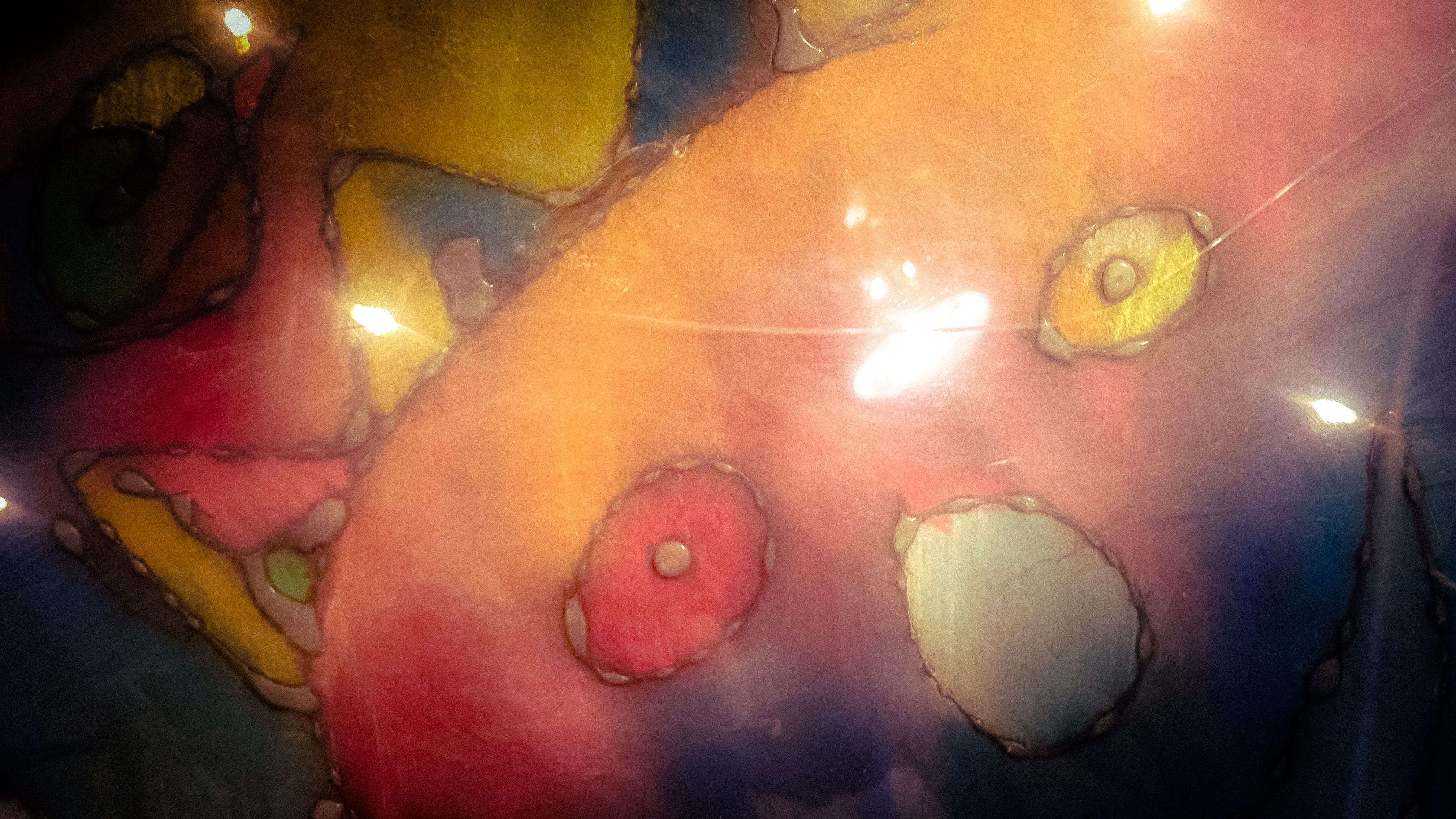
In the living room, a painting I cannot quite display. A sun with a smiling face made of pearl-dots, surrounded by small planets and a pentagram and a yin-yang and a script I cannot read. Signed on the back. A man ,named, made it for his mother Mary, who once lived in this house, and when she was gone the painting stayed, and when her daughter left the painting stayed, and now it is mine to hold or to release or to return.
These are four objects in the house I live in. None of them belong to me. All of them are mine now.
There are other inheritances.
*The spots on my skin.*
*The language I speak.*
*The urge to call from above like a crow.*
*The things that resolve from the old and the new world in juxtaposition in a new world.*
*To move to the sound of the music that flows through the neurons in my head.*
None of these I chose. All of them came from somewhere. A grandparent I did not meet. A language shaped by a thousand years of mouths I will never hear speak it. A migratory impulse bred into a nervous system before I was a nervous system. A rhythm already running when I arrived to inhabit it.
I used to think of a self as a thing you build. Now I think of a self as a thing you receive, and then slowly recognize, and then either honor or refuse.
My wife's family, they carry a rule: *do not cut your nails on Friday.*
Nobody knows why. Ask the grandmothers and you get a shrug, a *it's just what we do*. The rule survives. The reason was lost somewhere between the village and the boat and the next village and the apartment and the house and the daughter and the granddaughter and now me, the outsider who married in, asking the question nobody inside the family thought to ask, because the practice still works whether anyone remembers why.
This is how most of us carry our lineages. Not as explicit traditions we are initiated into. As rules whose reason has been stripped. As gestures our body makes before we notice. As aversions or preferences for candles on windowsills or phrases we say to babies in a language we otherwise do not speak. Fragments. The technique survived the theology. The gesture survived the grammar.
The temptation is to either dismiss the fragments (*it's just superstition, it's just culture, it's nothing*) or to elevate them into a complete system they are not (*this is an ancient practice*). Both moves miss what is actually happening. What is actually happening is that a partial transmission has reached you. You are holding a piece of something whose whole shape you cannot see. You get to decide how to be the custodian of a piece.
The house teaches me. A previous owner, or the mother of a previous owner, or someone before them, placed the horseshoe on the beam and the ladybug on the door and the flamingo on the switch and the painting on the wall, and the house held them all for long enough that by the time I arrived it was already a working. I walked into a tuned room. My job was not to redecorate. My job was to notice.
My wife's family teaches me differently. No objects, nothing to dust around, just a rule. Do not cut your nails on Friday. And because the rule is portable, it traveled further than any painting could, across a sea and through three generations, and landed in a kitchen in a country her great-grandmother never saw, and was still observed, still intact, without a single sentence of instruction accompanying it.
These are the two modes an inheritance arrives in. Material and behavioral. The horseshoe and the Friday. The artifact and the gesture. Both are the same kind of transmission in different containers.
I am writing this down because that is what the cards asked for.
I pulled a Lenormand last week on the painting. Anchor, Fish, Cross. Something anchored, something flowing from the deep, something carrying karmic weight. Then one card for *what do you want from me.* Book. Secrets, research, the thing that wants to be read.
The answer the painting gave is the answer all four objects give and the answer the Friday rule gives. *Receive. Witness. Record.* Not resolve. Not explain. Not complete. Just: notice that you are holding something, and let it be held consciously instead of unconsciously, and write down what you find.
So this is the first entry. The ladybug on the bathroom door. The flamingo on the switch. The horseshoe on the beam. The painting nobody quite wants and nobody quite releases. The rule about Friday nails my wife's grandmother never explained. The spots on my skin. The language in my mouth. The call rising in my chest like a crow's.
The things that resolve from the old and the new world in juxtaposition in a new world.
I did not choose any of it. It chose me, or it came through me, or it arrived at the house I happened to buy, and now I am the one awake enough to notice. That is what this series is. A slow accounting of what I am carrying. A record kept by someone who did not make the thing but has it in his hands now, and wants it to be held the way it deserves to be held, before the next generation inherits it and the reason slips one more link down the chain.
If any of this resonates with something in your own house, your own family, your own body, I would like to hear what you are carrying. These pieces live better when they are named alongside other people's pieces. That is the second thing inheritances do. They find each other once they are spoken…
Aloud
.